Part of Assess

Penetration testing and vulnerability analysis in Panama

A pentest, or penetration test, is a controlled, authorized assessment that attempts what an attacker would attempt, to show which gaps are real, how far they reach and how to fix them effectively.

What is included

  • External infrastructure and web application tests
  • Internal network tests: segmentation, VLAN hopping and privilege escalation
  • Active Directory assessment and attack paths to critical assets
  • Authorized red team exercises with agreed objectives
  • Controlled resilience tests on the platforms you authorize
  • Recurring vulnerability analysis (monthly or on demand) with prioritization
  • Retest to validate that every fix works

This is for you if

  • You are about to release a new application or a major change
  • You want to validate whether your controls would stop a real intrusion
  • You must show periodic testing to a regulator, a customer or an auditor

How we do it

  1. Rules of engagement

    We sign off scope, schedules, permitted techniques and emergency contacts before we start.

  2. Reconnaissance and discovery

    We map what an attacker would see from outside or from inside the network.

  3. Manual testing and controlled exploitation

    We chain weaknesses to show real impact, not just to list a scanner's alerts.

  4. Report and retest

    We deliver reproducible evidence and, once you have fixed the findings, we test again to confirm it.

What you receive

  • Executive report
  • Technical report with reproducible evidence and CVSS severity
  • Confirmed attack paths
  • Prioritized remediation plan
  • Retest with comparison between assessments

Frameworks and methodologies

  • PTES
  • OWASP WSTG
  • NIST SP 800-115
  • OSSTMM
  • CVSS

What the report we deliver looks like

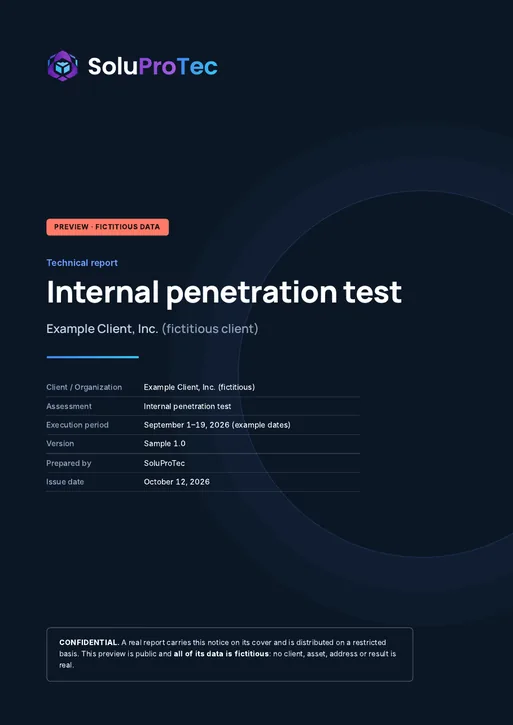
A sample technical report from an internal penetration test, with 100% fictitious data. Look at the preview or ask for the full report to see how we present findings, their severity and what to fix first.

  • Executive summary for management, with the main attack chain.
  • One sheet per finding: CVSS score, steps to reproduce, evidence and how to fix it.
  • A prioritized roadmap, with the closure criterion to validate each fix.

The full report (25 pages) is sent by email. Our team reviews each request and we reply within one business day.

Preview: PDF · 6 pages · 600 KB · Opens in a new tab

All content is fictitious: no client, asset or result is real.

Related experience

We group experiences without identifying clients or publishing sensitive data. Results correspond to the documented scope of each engagement.

See all experiences
  • Consolidated experience 01

    Multi-sectorPentesting

    Internal security and corporate identity

    Problem
    Weaknesses in configuration, services and identity could make unauthorized access easier inside the organizations assessed.
    Results
    • Privileged access paths validated in controlled tests.
    • Weaknesses and effective controls documented by scope.
    • Technical priorities based on the impact observed.

    Identities withheld

  • Consolidated experience 02

    Multi-sectorPentesting

    External exposure, web applications and digital risks

    Problem
    Applications, public services and information exposure called for a technical review to identify risks and guide fixes.
    Results
    • Findings prioritized by application and asset.
    • Information and component exposures identified.
    • Recommendations specific to the risk observed.

    Identities withheld

  • Consolidated experience 03

    Multi-sectorPentesting

    Mobile application security and technical code review

    Problem
    The applications assessed needed their authentication, communication, storage and software-component controls checked.
    Results
    • Weaknesses in mobile controls documented.
    • Observations separated by platform and application.
    • Fix priorities delivered for follow-up.

    Identities withheld

Consolidated experience 01

PentestingMulti-sector

Internal security and corporate identity

Sectors served

  • Banking
  • Government
  • Aviation
  • Legal
  • Private sector

Services offered / delivered

  • Internal penetration testing
  • Active Directory and AD CS assessment
  • Analysis of privileges and internal services

Context

This experience brings together internal assessments of corporate networks and identity services. Scope, controls and results varied between organizations.

Documented interventions

  • Review of internal services, authentication, privileges and configuration.
  • Controlled validation of access chains across identity services where the scope allowed it.
  • Documentation of successful tests, blocked attempts and mitigation recommendations.

Documented results

  • In some engagements, paths to critical privileges were demonstrated; in others, controls were observed that blocked techniques that had been tested.
  • The reports separated identified vulnerabilities from proven exploitation and made it possible to prioritize risk treatment.

Scope of the result

The results belong to the scope of each assessment. We do not claim that every organization or system was compromised, nor any later remediation where there is no revalidation.

Methodology

Controlled penetration testing, identity review and correlation of technical evidence.

Identities withheld

Consolidated experience 02

PentestingMulti-sector

External exposure, web applications and digital risks

Sectors served

  • Banking
  • Government
  • Aviation
  • Legal
  • Private sector

Services offered / delivered

  • External and web/API penetration testing
  • Black-box and gray-box assessments
  • OSINT and digital exposure intelligence

Context

This experience consolidates work on public-facing surfaces and applications, together with digital exposure investigations. Each engagement kept its own scope and methodology.

Documented interventions

  • Assessment of authentication, sessions, configuration and controls in web/API applications.
  • Review of published services, components, certificates and administrative surfaces.
  • In intelligence work, identification of public assets and of exposed identities or information.

Documented results

  • Findings and recommendations were delivered separately for each application, service or exposure investigated.
  • Some surfaces produced no findings in their tests. That result was not extended to other assets or to the organization as a whole.

Scope of the result

Exposure in external sources does not prove valid credentials, active sessions or an intrusion. A client's reply about fixes is not the same as an independent retest.

Methodology

Controlled testing of applications and services; research in external sources for the intelligence work.

Identities withheld

Consolidated experience 03

PentestingMulti-sector

Mobile application security and technical code review

Sectors served

  • Banking
  • Private sector

Services offered / delivered

  • Android and iOS mobile penetration testing
  • Static analysis and binary review
  • Code and API review in documented scopes

Context

This group brings together mobile assessments, each with its own testing approach and depth of analysis.

Documented interventions

  • Review of authentication, biometrics, communications and information protection.
  • Analysis of components, storage and application behavior.
  • Static, binary, code or API review only in the engagements that document those activities.

Documented results

  • The reports identified specific weaknesses and countermeasures by platform and application.
  • Risks in mobile controls and components were documented without turning each observation into evidence of malicious use by third parties.

Scope of the result

Not every application had a code review. The assessment reports do not establish that all fixes were implemented.

Methodology

Mobile testing and technical analysis of controls, with static analysis or code review depending on scope.

Identities withheld

Frequently asked questions

What is a pentest?

A pentest, or penetration test, is an authorized assessment in which we try to break into your systems with the techniques an attacker would use, to show which gaps are real and how to fix them. It runs on a scope agreed in writing and ends in a report with reproducible evidence and a prioritized remediation plan.

Do you offer penetration testing in Panama?

Yes. We run external and internal penetration tests from Panama, under signed rules of engagement, with reproducible evidence, a prioritized remediation plan and a retest to validate each fix.

Can penetration testing affect my systems?

Tests run under signed rules of engagement: scope, schedules, permitted techniques and emergency contacts. Resilience tests are only performed on the systems and in the windows you authorize.

What is the difference between vulnerability analysis and penetration testing?

Vulnerability analysis detects and prioritizes known weaknesses, with tools and validation. Penetration testing goes further: it chains weaknesses and exploits them in a controlled way to show real impact.

What is ethical hacking?

It is testing your systems with the techniques an attacker would use, but with written authorization, an agreed scope and a report of the results. Penetration testing is its most common form.

Is a retest included?

Yes. Validating each fix afterwards is part of our process, from diagnosis to validation.

Related services

Test your defenses with a controlled attack

Tell us which systems you want tested and the scope you have in mind. A SoluProTec specialist reviews your request and contacts you through the channel you provide.